
Keeping the tree
Tree Trimming in Atlantic Beach, FL
Short answer
Most tree trimming in Atlantic Beach, FL is live oak work: taking out dead wood, lifting limbs off roofs and driveways, shortening long heavy limbs that reach over a house, and thinning just enough that wind can pass through before hurricane season. LawnStarter's Jacksonville Beach averages, dated Nov 28, 2026, run $103 for a small tree, $400 for a medium one and $744 for a large one (LawnStarter, checked Nov 28, 2026).
Ordinary trimming rarely needs a city permit, though the beach cities' codes all frown on butchering a protected tree, and limbs touching power lines are the utility's to clear.
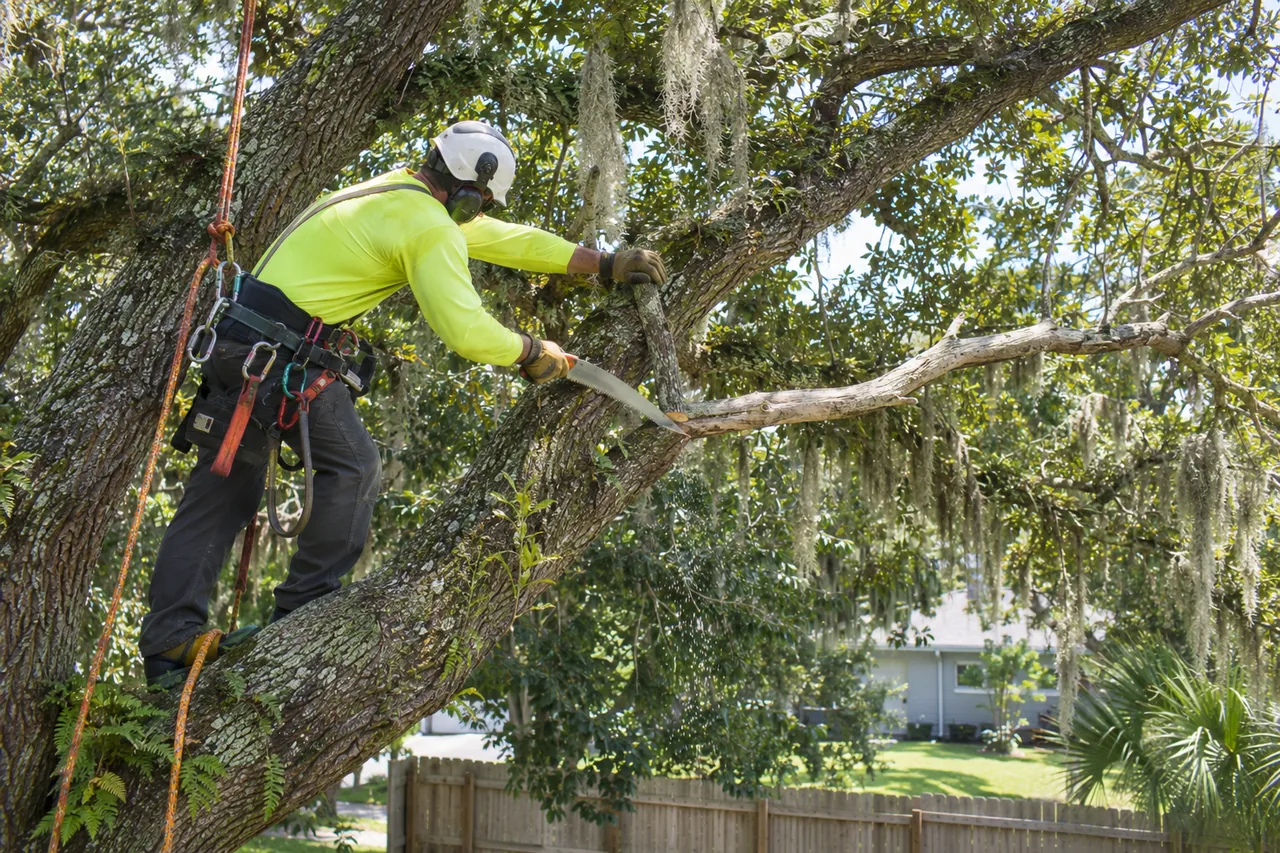
What does a good trim on a live oak look like?
- Deadwood out. Dead limbs, gray and barkless, come out first. They're what falls in a storm.
- Clearance. Limbs off the roof (6 feet or more is a common target), over the driveway high enough for a truck, and back from the wall so the house dries out.
- Reduction. Long limbs that reach out over the house are shortened back to a side branch, taking weight off the end.
- Light thinning. A few crossing or rubbing branches come out so the crown isn't solid.
What a good trim isn't: topping the tree, or stripping the inside of every limb so only tufts are left at the ends ("lion-tailing"). Both leave a weaker tree that sprouts dense regrowth. Atlantic Beach's code defines excessive pruning as irreversible removal or damage of more than 25 percent of a tree's natural shape or form, and Section 23-31(a) bars excessive or improper pruning on trees required under an approved tree protection plan (City Code Secs. 23-8 and 23-31, checked Nov 28, 2026).
When is the best time to trim at the beaches?
Late winter and spring, before hurricane season starts June 1, is when most homeowners book it, and JEA's own advice is to schedule tree work ahead of the season so it's done before a storm arrives (News4JAX, May 8, 2025). Live oaks can be pruned most of the year. Deadwood can come out any time. The one time to avoid big cuts is just ahead of a named storm, when fresh cuts and a suddenly thinned crown are no help.
Which trees need trimming most often here?
| Tree | Usual trimming work |
|---|---|
| Live oak | Deadwood, roof and drive clearance, reducing long horizontal limbs, every few years |
| Laurel oak, water oak | Deadwood and weight off limbs over the house; check for decay at the forks |
| Cabbage palm | Brown fronds, flower and seed stalks, loose boots; leave the green fronds (see palms) |
| Southern magnolia | Lifting low limbs, clearing the roof; heavy leaf drop in spring |
| Pines | Dead lower limbs; a pine's main job is usually just a check for lightning damage and beetles |
| Crape myrtle | Removing suckers and crossing branches, not cutting back to stubs every winter |
Should salt-burned or wind-sheared branches be cut?
Dead ones, yes. Live oaks and cedars near the dunes grow sheared, with the windward side short and the crown leaning inland. That shape protects the tree; trimming the windward side "even" opens it up to more salt and wind. A crew working near the ocean leaves that profile and takes only the dead twigs and branches.
Should Spanish moss be removed?
It doesn't need to be. Spanish moss is an air plant that doesn't feed on the tree. Heavy clumps on a tree that's already thin can be pulled while the climber is up there for deadwood, but stripping moss isn't a treatment, and it grows back.
What about limbs near power lines?
Limbs on or near the primary wires at the top of the pole are the utility's to clear: JEA in Atlantic Beach, Beaches Energy Services in Neptune Beach and Jacksonville Beach, which trims its neighborhood lines every two years (Beaches Energy, checked Nov 28, 2026). For limbs around the service wire to the house, ask the utility before anyone cuts. See trees and power lines.
Does trimming need a permit?
- Atlantic Beach. The permit is written for removals 8 inches and up, and the code has long treated excessive pruning as a violation where trees are kept under a protection plan. Heavy work on a landmark-size oak (20 inches and up) is worth a call to Community Development, (904) 247-5800, first.
- Neptune Beach. Section 27-445 requires a permit before anyone cuts, removes, relocates or damages a regulated tree; ask the city whether your pruning plan counts.
- Jacksonville Beach. The permit in Section 34-744 covers removing or damaging a protected tree; trees in the street right-of-way are generally the city's, so ask before touching them.
- Anywhere. Florida Statute 163.045 covers pruning and trimming as well as removal when an onsite risk assessment documents an unacceptable risk on a single-family lot.
What drives the price of a trim?
- Tree height and spread, and whether a climber or a bucket truck can reach it from the street;
- how much is over the house, the pool cage or the wires;
- how many trees, and whether the brush is chipped on the street or carried out through a side yard;
- palms by count and height (HomeGuide lists palm trimming at $100 to $650; checked Nov 28, 2026).
Full price tables are on the cost page.
Trimming questions
How often should a live oak be trimmed?
Every three to five years is typical for a yard oak over a house, with deadwood checks after any big storm.
Can a trim make a tree safer in a hurricane?
It helps when the work removes dead and weak wood and shortens limbs over the house. A tree with decay in the trunk isn't made safe by trimming the top.
Can I trim branches hanging over from a neighbor's tree?
Generally up to the property line, without harming the tree. Talk to the neighbor first; a cut that kills a protected tree can still bring the city in.