Pests and disease
Dying Trees in Atlantic Beach, FL
Short answer
The trees most likely to be dying in an Atlantic Beach, FL yard are redbays and swamp bays with laurel wilt, cabbage and other palms with lethal bronzing, and old laurel and water oaks rotting from the inside. Laurel wilt was first found in Florida on Fort George Island in Duval County in 2005, a few miles north of Mayport, and lethal bronzing has spread to 36 Florida counties and is becoming more common in northeast Florida (Florida Division of Forestry; UF/IFAS Duval County Extension, July 2025).
A dead tree near a house is a removal job, not a wait-and-see one: dead wood dries, gets brittle and drops in the next storm. Under Florida Statute 163.045, documenting the risk can also take the city permit out of the picture on a single-family lot.
What is laurel wilt, and how do I spot it?
A fungal disease carried by the tiny redbay ambrosia beetle, which bores into trees in the laurel family. In the Florida Division of Forestry's account, it was first found in the state on Fort George Island in 2005 and jumped to Indian River County in 2006. Hosts include redbay, swamp bay and silk bay, sassafras, avocado, and camphor tree.
The signs:
- leaves droop and discolor;
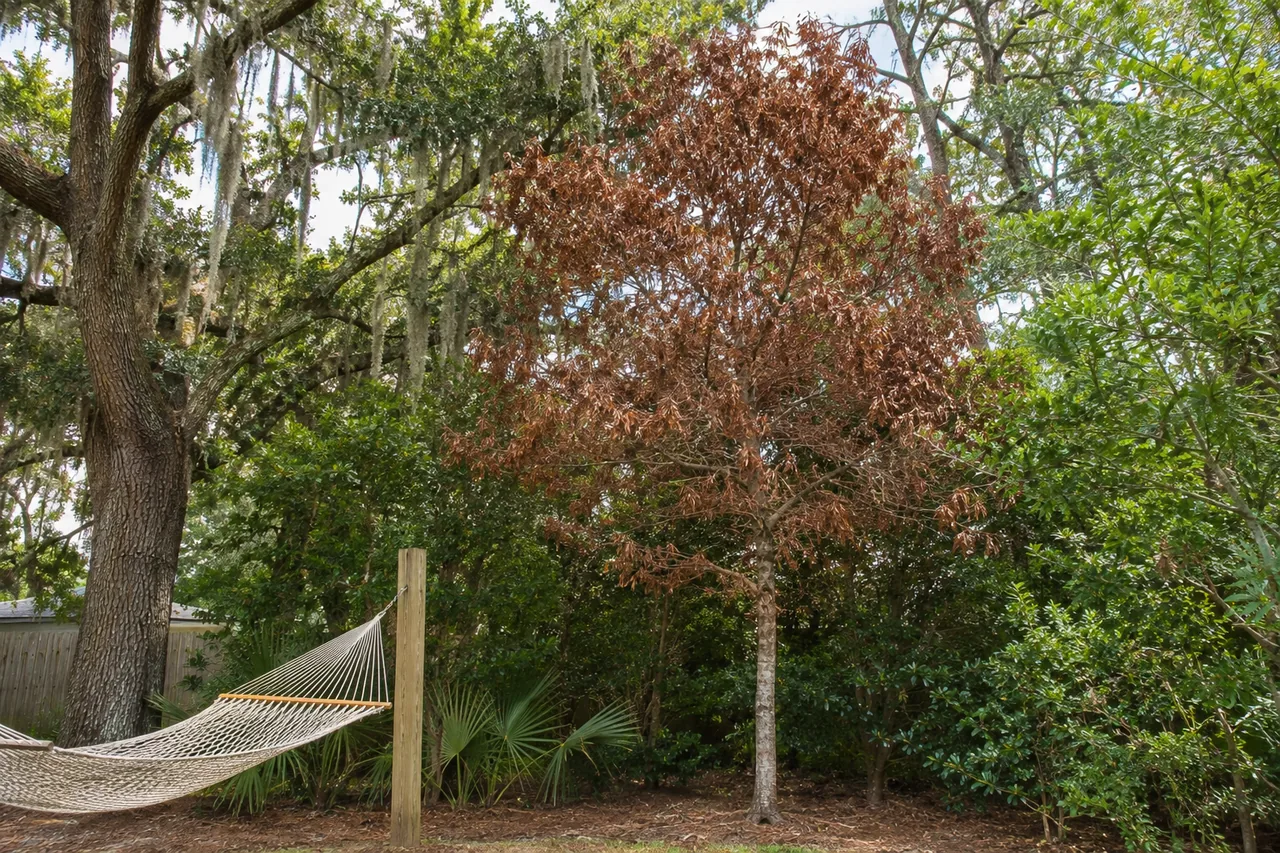
- the whole crown wilts, turning reddish to purplish brown, and the dead leaves often stay on the tree for a year or more;
- dark streaks in the sapwood under the bark;
- after the tree dies, thin tubes of sawdust sticking out of the trunk where beetles bored in.
The redbay ambrosia beetle and its fungus now occur in nearly 300 Southeastern counties, spread in part through the trade in wood products (UF/IFAS FR475, May 22, 2024). Redbay is part of the maritime hammock around Atlantic Beach, so dead bays in the back of a lot are common.
What should be done with a tree killed by laurel wilt?
Take it down before it falls, and keep the wood local. Florida's rule 5B-65, adopted in August 2010, restricts moving firewood and other unprocessed wood into and around the state, with exceptions that include moving wood less than 50 miles within Florida (Florida Division of Forestry presentation). Chipping on the lot, or hauling to a local yard waste facility, keeps the beetles from riding along to new trees.
How do I know a palm has lethal bronzing?
Larry Figart, Duval County's UF/IFAS urban forestry agent, lays out the order the symptoms show (UF/IFAS Duval County Extension, July 9, 2025, checked Nov 28, 2026):
- All the fruit or flowers drop at once (pruning can hide this).
- The spear leaf, the new frond at the center, dies, which means the palm's growing point is dead.
- The fronds turn reddish bronze and dry out, from the lowest fronds upward.
Symptoms appear four to five months after infection, and most palms die two to three months after the first one shows. The disease was first tied to sabal (cabbage) palms and date palms and now infects 21 species. It's caused by a phytoplasma spread by a sap-feeding insect.
There's no cure for a palm that has it. The extension advice is to remove a diagnosed palm right away to slow the spread, and to test nearby palms; injections every three months can protect healthy palms nearby. Pruning tools don't spread it, and palms can be replanted in the same spot. See palm removal.
Why do old laurel oaks and water oaks fail?
They grow fast and don't live long by oak standards, and decay often works through the trunk and the big limb unions for years before it shows. UF/IFAS places both in the lowest wind resistance group (UF/IFAS FR174). Warning signs worth a contractor's look:
- mushrooms or shelf-like conks on the trunk or at the base;
- a cavity, or a hollow sound when the trunk is tapped;
- dead limbs high in the crown while the lower crown is still green;
- a crack running down from a fork;
- a new lean, or sand heaving up on one side of the trunk.
What kills pines at the beaches?
Lightning, drought stress and bark beetles, often in that order. A pine struck by lightning, or stressed by a dry spring, draws bark beetles, and the needles go from green to yellow to red. Once a pine's needles have turned, it's dead, and a dead pine near a house drops limbs and bark within months. In Jacksonville Beach, pines other than cedars aren't protected trees under the city code; in Atlantic Beach and Neptune Beach they are, by size.
Does a dead or dying tree still need the city permit?
- Atlantic Beach. Section 23-22(3) exempts diseased or pest-infested trees once the city's administrator, a forester or an arborist inspects and finds removal is needed to keep the disease or pests from spreading, and Section 23-36 waives mitigation when the city orders a contagious diseased tree removed, as long as the lot still meets the minimum tree requirements. Check with Community Development, (904) 247-5800, before cutting.
- Neptune Beach. Replacement may not be required for diseased trees (Sec. 27-447(a)(1)(g)), and hazard trees documented by a qualified arborist can come down without a permit (Sec. 27-445(1)(b)).
- Jacksonville Beach. Diseased or weakened trees are exempt, and dead or deteriorated trees need no replacement with a written notice first (Sec. 34-744(b)(4) and (f)(4)).
- All three. Florida Statute 163.045 applies to single-family homes with a documented risk assessment. See the arborist letter page.
Code citations: Atlantic Beach Ch. 23; Neptune Beach Art. IX; Jacksonville Beach LDC. Checked Nov 28, 2026.