After a storm
Hurricane Tree Damage in Atlantic Beach, FL
Short answer
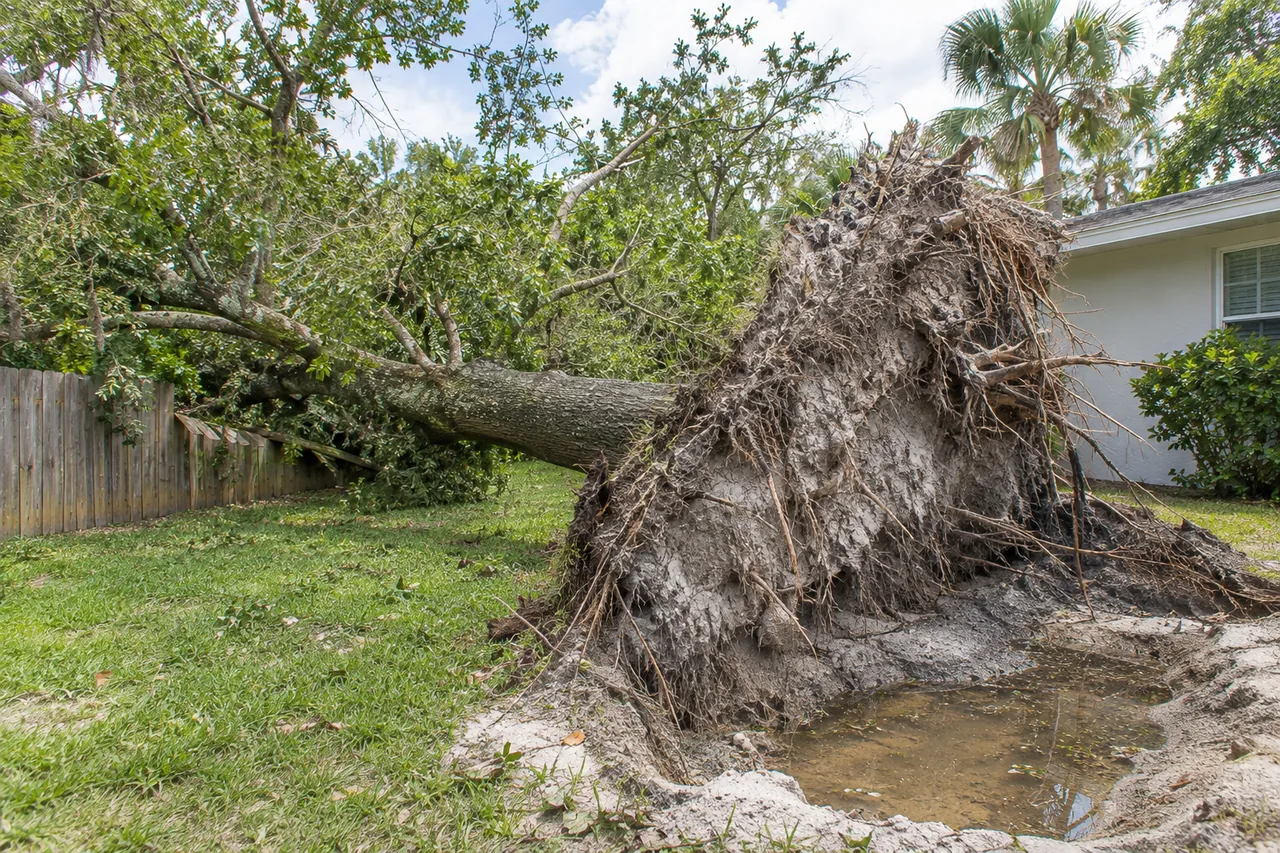
When a hurricane or nor'easter drops a tree on a house in Atlantic Beach, FL, the order is: people out of the damaged rooms, the utility called about any wire, photos for the insurance claim, then a tree crew to lift the weight off the roof and tarp the hole. Downed trees are the rule here after big storms: Hurricane Helene in September 2024 knocked down dozens of trees in Atlantic Beach and left most homes and businesses without power the next afternoon (News4JAX, Sept. 27, 2024).
Atlantic Beach's tree code exempts trees destroyed or badly damaged in a storm when the city finds normal permitting would hold up the work, but whoever claims the exemption has to prove it, so take pictures before anything is cut.
What should I do in the first hour after a tree falls?
- Get everyone out of the rooms under the tree. A trunk resting on rafters can shift as wind gusts keep working on the crown.
- Treat every wire as live. In Atlantic Beach, report it to JEA; in Neptune Beach and Jacksonville Beach, to Beaches Energy Services at 904-247-6171, its emergency and after-hours line (Beaches Energy, checked Nov 28, 2026). Don't touch a tree that's touching a line.
- Photograph everything before any cutting: the tree, the stump or root plate, the roof, ceilings, cars, fences. These photos serve your insurance claim and the city's emergency exemption.
- Call your homeowner's insurance company and write down the claim number.
- Then call the tree contractor to lift the load off the house and get the roof dried in.
How often do storms bring trees down at the beaches?
Often enough that most longtime residents have a story. These are the storms on record from the National Weather Service and other official sources.
| Storm | Date | What was recorded at or near the beaches |
|---|---|---|
| Hurricane Dora | Sept. 10, 1964 | Landfall near St. Augustine with winds estimated at about 115 mph, the first hurricane landfall there in the modern record; about $250 million in damage and 5 deaths (NOAA AOML). Jacksonville was without power for six days (News4JAX). |
| Hurricane Matthew | Oct. 7–8, 2016 | Gust to 76 mph at the Jacksonville Beach pier and a 76 mph reading 2 miles north of Mayport; the Mayport tide gauge peaked at 5.14 feet NAVD88, the second-highest there since the 1898 hurricane. In Putnam County a woman sheltering in a camper was killed when a tree fell on it (NWS Jacksonville). |
| Hurricane Irma | Sept. 11, 2017 | Gust to 78 knots, about 90 mph, at the Mayport station; 65 knots at the Jacksonville Beach pier; storm surge of 6.44 feet at Mayport; 7.96 inches of rain at Mayport Naval Station (NWS Jacksonville). |
| Hurricane Ian | Sept. 28–30, 2022 | Gust to 72 mph at Huguenot Park and 67 mph near Jacksonville Beach; a large tree fell on a power line at the Jacksonville Beach golf course, and in Duval County trees fell onto houses and displaced two families (NWS Jacksonville). |
| Hurricane Idalia | Aug. 30, 2023 | Gusts of 54 mph at Jacksonville Beach and 62 mph near Mayport; across Duval County a tree fell on a home, another uprooted onto an RV and others snapped onto power lines (NWS Jacksonville). |
| Hurricane Helene | Sept. 26–27, 2024 | In Atlantic Beach, three feeder circuits badly damaged, multiple spans of wire down on each, and dozens of fallen trees; JEA sent a tree crew, three line crews and four contract crews; Hanna Park closed (News4JAX). |
| Hurricane Milton | Oct. 9–10, 2024 | Gust to 64 mph at Mayport Naval Station, 53 mph near Jacksonville Beach and 51 mph in Neptune Beach; Jacksonville opened six shelters around the county and called voluntary evacuations (NWS Jacksonville). |
NWS Jacksonville's tropical event summary page listed no 2025 or 2026 storm reports when checked on Nov 28, 2026.
Why do so many beach trees go over roots and all?
Sand. The ridges the beach towns sit on are deep fine sand that drains fast and holds roots loosely, and toward the Intracoastal the sand stays wet much of the year above a dark, organic-stained subsoil layer. Roots spread wide and shallow, so a soaked tree in a long blow tips over as a flat plate of roots and sand rather than snapping. UF/IFAS hurricane studies rank laurel oak and water oak, two of the most common yard oaks here, in the lowest wind resistance group, and live oak in the highest (UF/IFAS FR174, checked Nov 28, 2026). More on the coastal trees and sand page.
Do I need the Atlantic Beach tree permit to clear storm damage?
Usually not for a tree the storm destroyed. Section 23-22(1) of the city code exempts "the removal of trees destroyed or severely damaged during or immediately following an emergency" such as a hurricane or tropical storm when the administrator determines that normal permitting would hamper work and compromise public safety, and 23-22(2) exempts trees posing imminent danger once the administrator inspects; the burden of proof is on whoever claims the exemption (City Code Sec. 23-22, checked Nov 28, 2026). So photograph the tree before cutting and call Community Development at (904) 247-5800 if you're unsure. A cracked tree still standing is a different case from one lying in the yard: it may need the permit or a risk assessment under FS 163.045. Jacksonville Beach's code lets its planning department temporarily waive the tree rules during a declared emergency (Sec. 34-744(c)).
How does a crew take a tree off a roof?
- Read the load first. The crew works out which part of the tree is holding weight on the house and which part is springing back under tension.
- Take the top off in small pieces. Limbs come off the roof side first, lowered on ropes or lifted with a crane so nothing drops through the rafters.
- Relieve the trunk last. Cutting the trunk where it bends can make it jump; tension wood is cut in stages.
- Tarp it. Once the weight is off, the opening gets covered against the next band of rain.
HomeGuide lists storm and emergency removal at $150 to $250 an hour and a crane day at another $500 to $2,500 (HomeGuide, checked Nov 28, 2026).
What can be done before hurricane season?
- Take dead and hanging limbs out of crowns over the house, especially in laurel and water oaks.
- Have a contractor look at any tree with a cavity, mushrooms at the base or a new lean.
- Thin live oaks properly so wind passes through; don't top them.
- Cut palm fronds that are fully brown, but leave the green ones.
- Keep the street address visible so crews can find the house, one of JEA's own storm tips (News4JAX, May 8, 2025).
Where does storm debris go?
Day to day, Atlantic Beach's hauler, GFL, picks up resident-cut limbs and fronds up to 5 feet long and 6 inches thick, 40 pounds a piece and 5 cubic yards a week, and tags and leaves debris a tree contractor creates (City of Atlantic Beach, checked Nov 28, 2026). After a major storm the city usually announces separate debris collection; check its notices. Properties north of Dutton Island Road are served by Jacksonville's contractors at (904) 630-2489.
Who's knocking on doors after the storm?
After every big blow, crews from out of the area drive the beach streets offering to cut. Before agreeing, ask whether the work needs the city's permit, get the price and the scope in writing, and don't hand over a large deposit up front. The hiring guide covers what the contract should say.