City rules
Atlantic Beach, FL Tree Permit Rules
Short answer
In Atlantic Beach, Florida, removing a tree 8 inches or more in diameter at breast height takes a city tree removal permit, a permit fee and a mitigation plan the city approves before the tree comes down (City of Atlantic Beach application, form dated Jan. 22, 2026; City Code Secs. 23-8 and 23-21; both checked Nov 28, 2026). Since July 13, 2026, big maritime trees, 20 inches and up, also fall under a stricter "landmark tree" rule that a fee or replanting can no longer buy past.
The rules live in Chapter 23 of the city code, "Protection of Trees and the Natural Environment," which the city rewrote in full in 2021 (Ord. No. 95-21-119). The exception on a house lot is Florida Statute 163.045: with qualifying arborist or landscape architect documentation that a tree poses an unacceptable risk, the city can't require the permit, fee or mitigation, though the new landmark section claims otherwise for big maritime trees (see the FS 163.045 page).
Which trees need the permit?
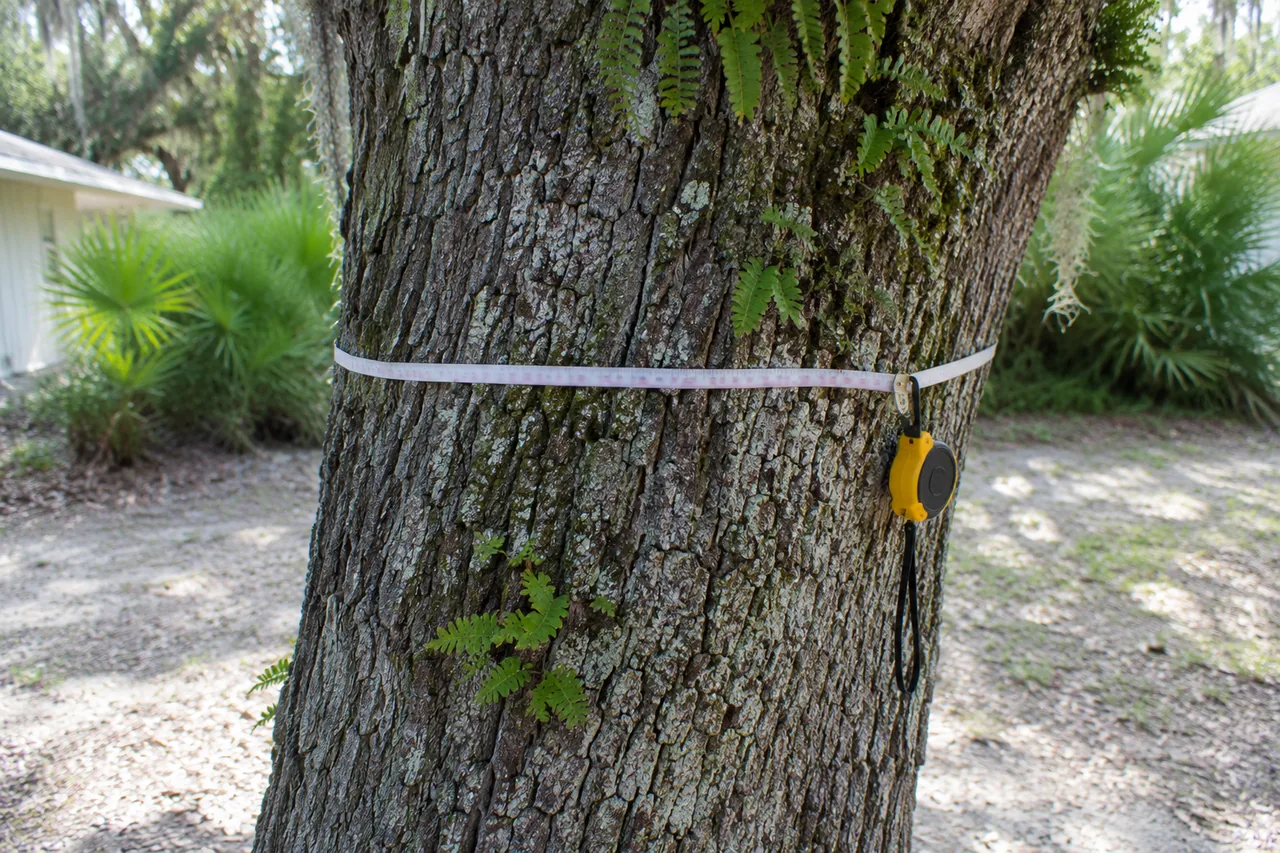
The city's application puts it in capital letters across the top: a permit is required for removal of trees 8 inches diameter at breast height and greater. The code says the same in its own terms: Section 23-21 requires a permit to remove a regulated tree, and Section 23-8 defines a private regulated tree as any tree on private property with a DBH of 8 inches or more, except species on the city's Prohibited Species List, invasives such as camphor tree, Chinese tallow, Brazilian pepper and Carolina laurelcherry (Sec. 23-35(b)). Diameter at breast height, or DBH, is the trunk's width measured 54 inches, four and a half feet, above the ground rather than at the flare; for a tree with several trunks, the code adds up the four largest (City Code Sec. 23-8, checked Nov 28, 2026). To turn a tape measure into a diameter, wrap the trunk at that height and divide the distance around by 3.14. A trunk 25 inches around is right at the 8-inch line.
Chapter 23 applies to all land in the city, single-family lots included (Sec. 23-2). The application lists what goes in with it:
- Exhibit A, a signed acknowledgment of the tree permitting process;
- Exhibit B, proof of ownership (a copy of the warranty deed) or a letter of authorization if someone else applies for the owner;
- Exhibit C, a tree inventory and site plan;
- Exhibit D, a tree worksheet.
The city's checklist adds one digital survey or site plan showing the trees to be removed or saved. Inspections are scheduled online through BSA Online. Staff say they'll be in touch about 10 days after submission if something is missing, and permits are issued about 7 to 10 business days after all the right documents are in and approved; nothing is issued until every division signs off and payment is made (permit checklist, checked Nov 28, 2026). The code adds that the permit has to be posted at the front of the property before any tree comes down, and that it expires if work doesn't start within six months (Sec. 23-23(e) and (g)).
Community Development Division, 800 Seminole Road, Atlantic Beach, FL 32233: main line (904) 247-5800, inspections (904) 247-5822. Tree questions and heritage trees: (904) 247-5817 or trees@coab.us (city heritage tree page). Checked Nov 28, 2026.
What does the permit cost?
Section 23-26 of the code as published online sets the permit application fee at $125 per lot for single- or two-family homes and $250 for multifamily, commercial, institutional and other uses, plus $50 for an extension or a reinspection, $125 for an appeal and $300 for a variance; the January 2026 application shows the same $125.00 and $250.00 (City Code Sec. 23-26, checked Nov 28, 2026). Those amounts may already be out of date. Ordinance No. 5-26-75, passed 5–0 on final reading July 13, 2026 and not yet folded into the online code, moved city fees into Chapter 2 and lists "Residential Tree Removal" in a new Section 2-530 at a $150 plan review fee and a $150 inspection fee, $325 in total, with mitigation fees in addition (Ord. No. 5-26-75; July 13, 2026 minutes; checked Nov 28, 2026). Ask Community Development which fee it charges now.
Cutting first costs more: an after-the-fact permit carries twice the normal application fee (Sec. 23-51(d)(1)). The bigger number is often the mitigation, which is separate from the fee.
What is mitigation, and how is it figured?
Mitigation is how the city makes up for the canopy a removal takes away. The application's Exhibit A lists the ways to meet it, citing Section 23-33: keeping or relocating existing trees, planting new ones, or paying into the city's tree fund. The code makes replanting or relocation the preferred methods and reserves the fund for cases where replanting on the lot is restricted by things like rights-of-way, utilities, stormwater facilities or septic fields; it says a fund payment "shall not be construed as a routine mitigation option" (Secs. 23-33(a) and 23-37, checked Nov 28, 2026). Then the steps run on a clock:
- Staff send a Tree Permit Calculations sheet listing the mitigation owed.
- Your mitigation plan is due within 30 days of getting the calculations, and it has to be approved before the trees come out.
- Replacement trees go in within 30 days of the permit being issued, or before a certificate of occupancy or completion on a building job.
- A fund payment is due within 7 days of the permit.
- Whatever is planted, kept or moved has to survive three years after the permit is finaled.
How many inches? Table 1 in Section 23-33(b) sets the ratio by lot type and trunk size. On an existing house lot, a tree under 14 inches DBH owes half an inch for each inch removed, a 14- to 29-inch tree inch for inch, a tree 30 inches or more two inches per inch, and a heritage tree three; for new construction the ratios are 1:1.5, 1:2, 1:3 and 1:4. Removed oaks are replaced with oaks unless the fund is paid, palms can only replace palms, and replacement oaks start at 4-inch caliper and 12 feet tall (Sec. 23-33(f)).
In a July 13, 2026 handout setting the old rules beside the new ones, city staff worked three sample trees under the code in force before the change: a 12-inch cabbage palm owed 18 inches of mitigation, a 30-inch live oak 60 inches and a 10-inch maple 15 inches, 93 inches in all, with a 10-day staff review (Commission minutes, Attachment E, checked Nov 28, 2026).
| Property | What the city said was owed | Works out to |
|---|---|---|
| 445 West First Street: one live oak, 60 inches DBH, about 240 years old | More than 54 inches of replacement trees, or about $9,841.88 to the Tree Protection Fund, or a mix | About $181 per inch |
| 1895 Hickory Lane, Selva Marina: a lot split with about 17 trees slated to go | 636.5 inches after the maximum 40-inch preservation credit, $115,206.50 | $181 per inch |
Sources: City notice, Jan. 22, 2026; City notice, Jan. 26, 2026; tree count from Jacksonville Today, Feb. 2, 2026. The per-inch figure is the city's dollar amount divided by its inches. The code doesn't print a per-inch fund rate; Section 23-37 leaves the value to the City Commission (checked Nov 28, 2026).
The Hickory Lane notice also shows Florida law at work: the developer planned an arborist letter, and the city noted that if a Level 2 basic tree risk assessment found specific trees high-risk or dead, mitigation for those trees would be eliminated under state statute.
Why did Atlantic Beach tighten its tree code in 2026?
Because of one live oak. On Jan. 20, 2026, a live oak 60 inches across and estimated at about 240 years old was cut down at 445 West First Street, a lot backing up to the Tide Views Preserve, so the newly split parcel could be built on. The city posted that issuing the permit was "a mandatory administrative formality": the applicant met every objective criterion in the code and staff had no legal alternative (City of Atlantic Beach; Jacksonville Today; checked Nov 28, 2026).
Neighbors pushed back. At the Jan. 26 commission meeting Mayor Curtis Ford called it a glaring problem and asked staff to look at stronger rules; the city manager's report that week said the code had left the city powerless to stop the removal and set workshops on Chapter 23 for March 2, 2026, to redefine legacy trees, raise mitigation and look at protecting heritage-sized live oaks (City Manager report, Jan. 26, 2026).
What exactly did Ordinance 95-26-128 change?
Here is the record, step by step:
| Date | Step |
|---|---|
| May 13, 2026 | The Environmental Stewardship Committee moves to protect maritime trees 20 inches DBH or greater as landmark trees, with proof that keeping the tree is infeasible, a minimum 30-day pause for the city arborist to examine it, and an exception for trees that are dead or a clear danger. |
| June 22, 2026 | Introduction and first reading. As drafted, the ordinance added a definition of "landmark live oak tree" to Section 23-8 and created Section 23-42 in Article IV, Division 5 (Areas of Special Concern). The Commission amended it on the spot to cover all maritime forest species at 20 inches DBH, and it passed first reading. |
| July 13, 2026 | Public hearing and final reading, passed 5–0. The motion adopted the staff report's mitigation ratio, doubled the mitigation fee for trees within the setback, made the Community Development Board the body that grants final approval for removal, with appeals to the City Commission. |
| Aug. 10, 2026 | A "Tree Protection Code Update (Phase 2)" appears on the Commission agenda for the remaining gaps, including the cost and feasibility of moving trees. |
Sources: June 22, 2026 agenda packet; first-reading summary; Aug. 10, 2026 packet with the July 13 minutes. Checked Nov 28, 2026.
The draft's effective-date clause read: "This ordinance shall take effect upon final reading and approval." That puts the landmark rules in force from the July 13, 2026 vote. The online code, current through February 2026 ordinances (Supplement 52, posted Aug. 21, 2026), still shows Section 23-42 as "Reserved"; Municode lists Ordinance 95-26-128 among adopted ordinances not yet codified, with its text (Ord. No. 95-26-128, checked Nov 28, 2026).
In plain terms, for a homeowner:
- Which trees. The ordinance defines landmark trees as "designated maritime species at least 20 inches of diameter at breast height (DBH) or greater" (Ord. No. 95-26-128). Section 23-8 lists those species: bald cypress, southern and eastern red cedar, winged and Florida elm, live oak, pecan, mockernut and pignut hickory, loblolly bay, southern and sweetbay magnolia, red and Florida maple, tupelo, and loblolly, longleaf and pond pine. Laurel oak, water oak, slash pine and palms aren't on it. The mayor said invasive trees and trees not characteristic of Atlantic Beach were left out (News4JAX, July 17, 2026; Sec. 23-8; checked Nov 28, 2026).
- Money no longer settles it. Paying into the fund or replanting on the lot is no longer enough to take down a landmark tree. The adopted text lets the board approve removal only when the applicant shows the work "cannot occur in any other location on the site," or that removal "is unavoidable due to site conditions and/or design considerations beyond the control of the applicant." Before approving, the city can require the tree to be relocated at the owner's expense, and planting credits count only for replacement designated maritime species of at least 4-inch caliper, on a landscape plan city staff approve first.
- Who decides. Removal must be approved by the Community Development Board, with appeals to the City Commission.
- How long. Staff estimated two to three months for a landmark case, against 10 days of staff review under the old code.
- Setbacks and cutting without a permit. When the board allows mitigation, the rate doubles for landmark trees in the required setbacks, and a landmark tree removed without a permit is mitigated at double the rate. The mayor's point was that setbacks are meant to be green space.
The mayor called it the most significant tree ordinance the city had ever really considered, and said the aim wasn't to make building on one's own lot onerous.
What is a heritage tree?
A separate, older tier. Section 23-8 defines a heritage tree as a designated maritime species 30 inches DBH or more that the City Commission declares to be of unique or intrinsic value for its age, size, species, or cultural, ecological or historical significance; on private property the owner has to nominate it voluntarily, and Section 23-41 has the Commission designate it by resolution (City Code, checked Nov 28, 2026). The city's heritage page says sixteen have been designated since 2015, all live oaks, one of them hugging a cypress, each marked with an engraved metal plaque, and that on city-owned land every cypress, live oak and magnolia 30 inches or more in diameter is included. Designation doesn't forbid removal, but heritage trees are mitigated at a much higher rate: three inches for each inch removed on an existing house lot under Table 1 (City of Atlantic Beach, page dated Jan. 28, 2025, checked Nov 28, 2026).
What about dead trees and storm damage?
Section 23-22 lists the exemptions, and the person claiming one carries the burden of proving it; the administrator may ask for an arborist's documentation. Trees destroyed or severely damaged during or right after a hurricane, tropical storm, tornado, flood or other act of nature are exempt when the administrator determines that normal permitting would hamper work and compromise public safety. Trees posing imminent danger are exempt once the administrator inspects and finds that immediate removal is required, and diseased or pest-infested trees once the administrator, a forester or an arborist inspects and finds removal is needed to stop the spread. Section 23-22(8) also carries over exemptions in Florida Statutes (City Code Sec. 23-22, checked Nov 28, 2026). Each of these turns on the city's own finding, so call Community Development before cutting a tree you think is exempt and take photos first. For a house lot, the state's arborist-documentation route is the other path, with an open question for landmark trees; see the FS 163.045 page.
Who gets in trouble for cutting without a permit?
Not only owners. Under Section 23-51, the people who can be charged include the owner, agent, contractor or anyone else using the land, and anyone who knowingly takes part; each tree removed in violation is a separate offense, and regulated trees removed without a permit are assessed at twice the normal mitigation (City Code Sec. 23-51, checked Nov 28, 2026). In March 2022 the city warned residents about an out-of-town tree company soliciting tree work door to door without the required permit; the city manager told the owner the company could be cited up to $500 per violation, and residents were asked to send details, including doorbell camera footage, to info@coab.us (City consumer alert, March 15, 2022, checked Nov 28, 2026). The city's advice in that alert: call before you cut. A tree crew worth hiring here will ask whether the permit is in hand before the saw starts.
What to have ready before you call the city or a contractor
- The trunk's distance around at about four and a half feet, for each tree;
- the species, if you know it (live oak, laurel oak, cabbage palm, magnolia, pine, cedar);
- a phone photo of where each tree stands relative to the house and the lot lines, since setbacks now matter;
- your deed or a letter of authorization;
- any arborist report you already have.
Rules change, and a Phase 2 code update was on the Commission's August 2026 agenda. Confirm the current requirements with the city before work is scheduled.