Ground and trees
Atlantic Beach, FL Trees and Sandy Soil
Short answer
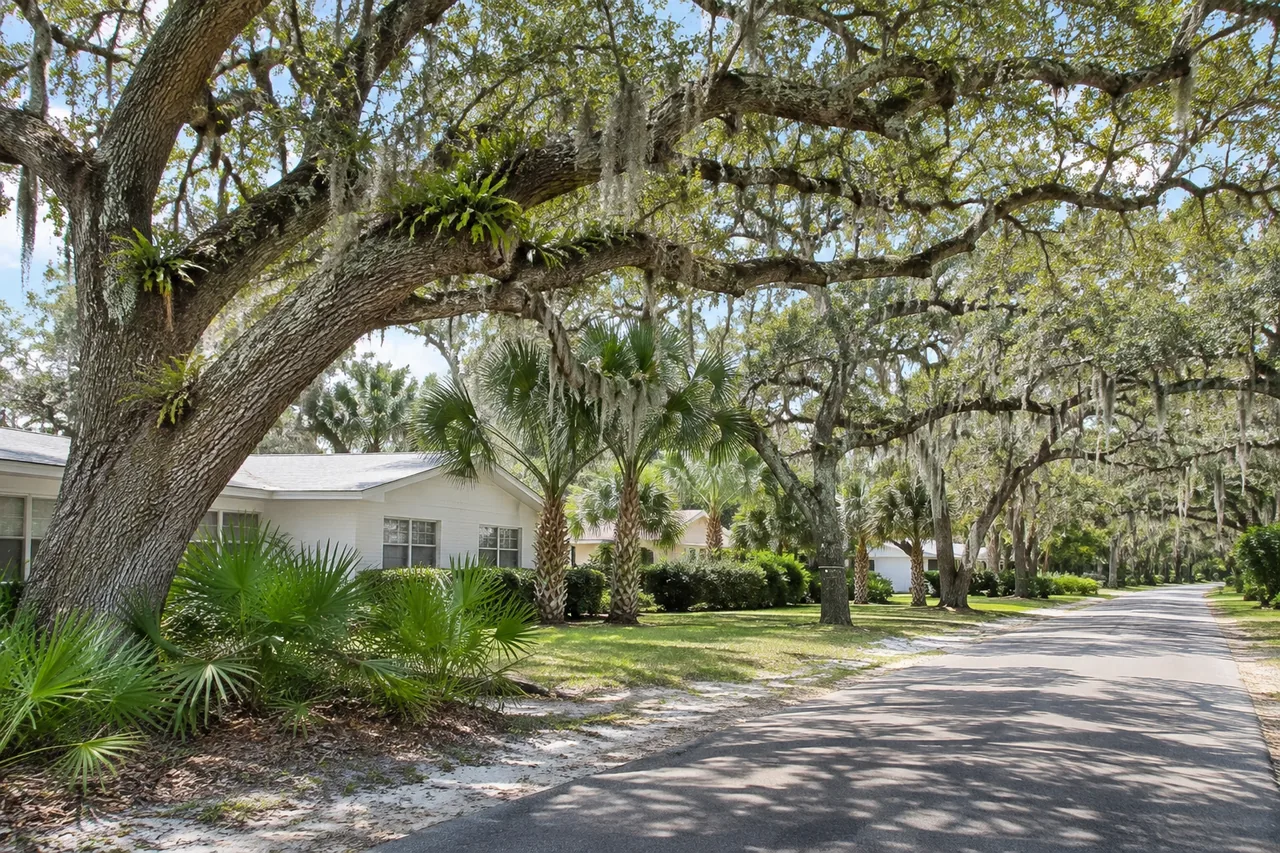
Atlantic Beach, FL yards grow on sand: old dune ridges of fine, fast-draining sand nearest the ocean, and wetter flatwoods sand over a dark, organic-stained subsoil toward the Intracoastal Waterway. The trees that grow there best, and hold on in hurricanes, are the maritime forest natives, live oak, southern magnolia and cabbage palm, while the laurel oaks and water oaks common in older yards are among the first to fail in high wind.
That mix of sand and species explains most of what a tree crew finds here: wide, shallow roots, trees that tip over as a flat plate of roots rather than snapping, and a city code built to keep the maritime canopy.
What is the ground under an Atlantic Beach yard?
Two kinds of sand, mostly. On the coastal dunes, the USDA describes soils like the Fripp series: excessively drained fine sand, "very slow runoff; rapid permeability," with less than 5 percent silt and clay to more than 80 inches down, forming on undulating to steep dunes next to beaches and waterways. The native cover listed for Fripp reads like an Atlantic Beach yard: wax myrtle, live oak, palmetto, slash, loblolly and longleaf pine, cabbage palm, yaupon and American holly (USDA Official Series Description, Fripp, checked Nov 28, 2026).
A few miles west, the flatwoods sands are different. The Mandarin series, whose type location is in Duval County about 3,000 feet north of Atlantic Boulevard and 0.7 mile west of Girvin Road, is somewhat poorly drained sand with a dark, organic-stained layer, a spodic horizon, starting around 26 inches down in the typical profile, and a seasonal water table 18 to 42 inches below the surface (USDA Official Series Description, Mandarin, checked Nov 28, 2026). Roots in soils like that stay in the top couple of feet.
The lot-by-lot soil map is in the USDA's Web Soil Survey; a contractor with a probe bar will feel the difference in minutes.
What does sand do to roots and to falling trees?
- Roots spread wide, not deep. In dry dune sand, roots chase water sideways near the surface. Over a dense subsoil layer or a high water table, they can't go down.
- Soaked sand lets go. After days of rain ahead of a hurricane, wet sand loses its grip, and a tall tree with a full crown levers over. The root plate comes up flat and wide with sand packed in it, leaving a shallow, wide hole.
- Digging is easy, which matters for stumps. A grinder goes through sand quickly, but the roots run far, and buried lines are often shallow.
- Construction hurts. Trenching or a driveway pour within the root zone of a big oak cuts a large share of its roots. That's why the city's codes put barriers around trees kept on a building lot.
Which trees hold up best in hurricanes here?
UF/IFAS researchers ranked Coastal Plain species by how they fared in hurricanes from Andrew in 1992 through Charley, Frances, Ivan and Jeanne in 2004 and Dennis in 2005 (UF/IFAS FR174, Selecting Coastal Plain Species for Wind Resistance, checked Nov 28, 2026). The beach trees fall into it like this:
| Group | Trees you'll see in Atlantic Beach, Neptune Beach and Jacksonville Beach |
|---|---|
| Highest | Live oak, sand live oak, southern magnolia, yaupon and dahoon holly, crape myrtle, bald and pond cypress |
| Medium-high | Sweetgum, sweetbay magnolia, Shumard oak |
| Medium-low | Slash, loblolly and longleaf pine, wax myrtle, redbay, camphor tree, red maple, black cherry |
| Lowest | Laurel oak, water oak, southern red cedar, sand pine, pecan, Washington fan palm, Chinese tallow |
The same paper calls the sabal (cabbage) palm highly wind resistant, though it doesn't place it in the table. Chinese tallow, it notes, is prohibited in Florida.
What are the main trees on beach lots?
Live oak
The tree Atlantic Beach's code is built around. Low, wide and very long-lived: the oak cut at 445 West First Street in January 2026 measured 60 inches across and was estimated at about 240 years old (City of Atlantic Beach). All 16 heritage trees the city had designated since 2015 are live oaks, one of them hugging a cypress (heritage trees). Most live oak work here is pruning, not removal: deadwood, roof clearance, and reducing long, heavy limbs.
Laurel oak and water oak
Fast-growing shade trees planted widely in mid-century yards. They're in UF's lowest wind group, and older ones often hide decay inside. These are a large share of the removals done here.
Cabbage palm
Florida's state tree, salt-tolerant and wind-firm. Jacksonville Beach's code doesn't treat an unplanted palm as a protected tree; Atlantic Beach's staff, in their July 2026 examples, counted a 12-inch cabbage palm as owing 18 inches of mitigation under the old rules. See palms.
Southern magnolia
High wind resistance, big evergreen leaves, and on Atlantic Beach's list of designated maritime species, which get landmark protection at 20 inches (City Code Sec. 23-8).
Slash and loblolly pine
Tall and narrow over many older houses, medium-low in UF's wind ranking, and exempt from Jacksonville Beach's protected-tree list (other than cedars). Atlantic Beach's maritime species list names loblolly pine but not slash pine. Lightning and beetles kill them standing.
Southern red cedar
Salt-tolerant, common on the dune edge, but in UF's lowest wind group. Atlantic Beach lists southern red cedar among its designated maritime species.
Redbay and wax myrtle
Understory natives of the maritime hammock. Redbays across northeast Florida have been dying of laurel wilt since 2005; see dying trees.
What does salt do to beach trees?
Salt spray off the ocean burns leaves and twigs on the windward side of a crown, so trees nearest the dunes grow low and lean inland, their tops sheared by the wind. Natives like live oak, cabbage palm, yaupon and wax myrtle handle it; many inland ornamentals don't. When a storm surge or king tide floods a yard with seawater, trees that look fine for weeks can brown out later as the salt works into the roots.
Is Spanish moss hurting my oak?
No. Spanish moss is an air plant that takes its water and nutrients from the air and rain, not from the tree. It hangs heaviest on slow, older trees with open crowns, which is why it seems to be on every old live oak. On a tree already declining, heavy moss can add weight and shade inner leaves, so a contractor may thin it while pruning deadwood, but stripping it isn't a fix for a sick tree.
What should go back in after a removal?
If the city requires replacement, it has its own lists: Atlantic Beach's recommended species list in Section 23-33(f), Neptune Beach's six approved palms and 4-inch minimum caliper replacements, Jacksonville Beach's oak-based replacement math. Beaches Energy's planting guide asks for room: at least 50 feet away for trees that grow over 40 feet tall (Beaches Energy, checked Nov 28, 2026). A live oak or magnolia set well back from the house and the wires is the long-term choice the UF wind data supports.