One town south
Jacksonville Beach, FL Tree Permit Rules
Short answer
In Jacksonville Beach, Florida, most trees 6 inches in diameter or more are protected trees, and removing one takes a site clearing and tree removal permit from the city's Planning and Development Department (City of Jacksonville Beach FAQ; Land Development Code Sec. 34-744; checked Nov 28, 2026). The big difference from its neighbors: pines other than cedars, and palms that weren't planted to meet a landscape plan, aren't protected trees at all.
Replacement is lighter, too: at least one-third of the trunk inches removed, except live oaks and specimen trees, which are replaced inch for inch.
Which section of the code is it?
Section 34-744, "Site clearing and tree protection standards," in Article VII, Division 3 (Site Clearing and Landscape Standards) of the Land Development Code, Chapter 34 of the city code. Its history line reads "Ord. No. 7500, § 8.3(D), 8-19-91; Ord. No. 2006-7919, § 1, 4-3-06." An older city PDF still posted online prints the same text as Section 34-424, the number it carried before the code was renumbered (city PDF). Both checked Nov 28, 2026.
What counts as a protected tree?
The city's code enforcement FAQ puts it simply: most trees six inches in diameter or more are protected and need a permit to be removed. Section 34-744(b) then takes several groups off the list:
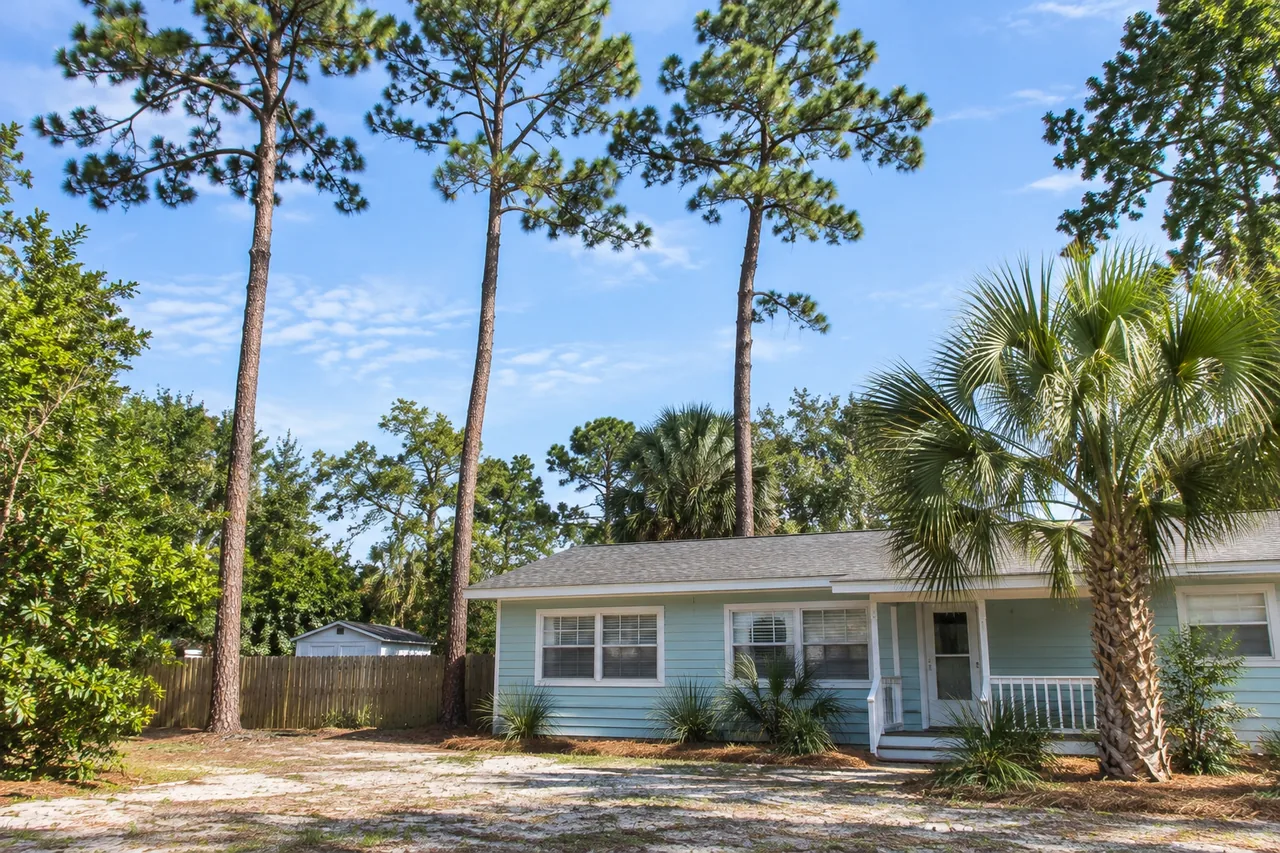
- (b)(1) Pines and palms. "Pine, except cedar trees," and "palm trees, unless planted to meet a requirement of an approved landscape plan." So a slash pine or a self-sown cabbage palm in a Jacksonville Beach yard isn't a protected tree.
- (b)(2) Invasive species. Listed invasives such as Brazilian pepper and melaleuca can be removed with a permit and an inspection to confirm the species.
- (b)(3) Nursery stock. Trees in botanical gardens and approved government nurseries and groves.
- (b)(4) Danger and disease. Trees posing imminent danger, or diseased or weakened, are exempt; the director may ask for written confirmation from a qualified person.
The code also has a top tier, the "exceptional specimen tree": a tree the city council finds "of unique and intrinsic value to the general public" for its size, age, history or ecology, plus any Florida state champion tree. The planning director keeps the list.
When does the permit come into play?
Under Section 34-744(a) and (d), the permit is needed before removing or damaging a protected tree, and before the city issues any construction, paving or surfacing permit on the lot. Heavy equipment over the roots or a grade change near the trunk counts as damage. For a single-family house on a lot under half an acre, the owner may draw the plans; other projects need plans from a qualified professional. Apply at the Planning and Development Department at City Hall.
How much replanting does Jacksonville Beach want?
| Situation | Rule |
|---|---|
| Protected trees in general | Replacement equal to at least one-third of the total DBH removed |
| Live oaks and specimen trees | At least 1 inch of replacement for each inch of DBH removed; other oaks may be approved by the department |
| Trees kept on the lot | May count toward replacement if a pervious area is kept within the dripline, one foot across for each inch of DBH |
| Dead or deteriorated trees | No replacement, when the cause is natural and written notice of that finding is given before any work |
| No room on the lot | A payment to the landscape and tree protection trust fund based on the retail price of a 2-inch caliper oak for every 2 inches owed |
A worked example: remove a 24-inch water oak and a 15-inch live oak. The water oak owes a third, 8 inches; the live oak owes all 15. That's 23 inches of new trees, or the trust fund equivalent at whatever a 2-inch oak retails for that year.
What does the code expect during construction?
Trees being kept need a barrier at least 6 feet from the trunk or around half the dripline, under 34-744(g)(1), and a sign at least 2 feet by 2 feet. The sign's required wording is blunt: "ANY PERSON DAMAGING ANY MARKED TREES WILL BE SUBJECT UP TO A FINE OF UP TO $250.00 PER DAY AND A STOP WORK ORDER."
Are the rules different after a hurricane?
They can be. Section 34-744(c) lets the Planning and Development Department temporarily waive the requirements during "a period of emergency, per State Statutes, such as a hurricane, flood or other natural disaster." Watch the city's announcements after a storm rather than assuming the waiver is on.
Why does the pine and palm exemption matter so much here?
Because pines and palms are a big share of the trees on Jacksonville Beach lots. Slash and loblolly pines grow tall and narrow over many older houses, and UF/IFAS wind studies put slash and loblolly pine in the medium-low wind resistance group (UF/IFAS, Selecting Coastal Plain Species for Wind Resistance, checked Nov 28, 2026). Removing one in Jacksonville Beach doesn't run into the protected-tree permit that a pine across the line in Neptune Beach or Atlantic Beach would. Call the city anyway if the tree was planted as part of an approved landscape plan, as palms often are on newer lots.
Who owns the power lines in Jacksonville Beach?
Beaches Energy Services, the city's own electric utility, founded by Jacksonville Beach residents in 1915 and serving more than 36,000 customers in Jacksonville Beach, Neptune Beach, Ponte Vedra Beach and Palm Valley (Beaches Energy, checked Nov 28, 2026). Its emergency and after-hours line is 904-247-6171. More on trees and power lines.
The section text on this page came from the city's Land Development Code document and its Sec. 34-424 PDF. Figures and section numbers can change; confirm with Jacksonville Beach Planning and Development before work starts (checked Nov 28, 2026).