State law
Florida Tree Law 163.045 at the Jacksonville Beaches
Short answer
Florida Statute 163.045 bars Atlantic Beach, Neptune Beach and Jacksonville Beach from demanding a notice, application, approval, permit, fee or mitigation for pruning, trimming or removing a tree at a single-family home when the owner holds a written, onsite tree risk assessment showing the tree poses an unacceptable risk. The city also can't make the owner replant it (Fla. Stat. 163.045, checked Nov 28, 2026).
The catch is the paperwork. The assessment has to follow a specific industry method, be done by one of two kinds of professional named in the law, and conclude that removal is the only practical way to bring the tree's risk below moderate. A worried feeling about a big oak isn't enough.
What does the statute actually say?
The law took its current form in 2022, when the Legislature rewrote the 2019 version; that act took effect July 1, 2022 (SB 518, enrolled; history line "s. 1, ch. 2019-155; s. 1, ch. 2022-121"). No later change turned up in a search of the Senate's bill records (checked Nov 28, 2026). Its working parts:
- Subsection (1)(a), documentation. "An onsite assessment performed in accordance with the tree risk assessment procedures outlined in Best Management Practices - Tree Risk Assessment, Second Edition (2017)," done "by an arborist certified by the International Society of Arboriculture (ISA)" or by a Florida landscape architect, and signed by whoever did it.
- Subsection (1)(b), residential property. "A single-family, detached building located on a lot that is actively used for single family residential purposes," and that is a conforming or legally recognized nonconforming use under the city's land development rules.
- Subsection (2), the rule. No local notice, application, approval, permit, fee or mitigation when the owner obtains that documentation showing "the tree poses an unacceptable risk." The statute defines it: "A tree poses an unacceptable risk if removal is the only means of practically mitigating its risk below moderate."
- Subsection (3), replanting. No local government may require the owner to replant a tree pruned, trimmed or removed under the section.
- Subsection (4), mangroves. The section doesn't touch delegated mangrove protection authority under ss. 403.9321–403.9333. That matters on the marsh edge along the Intracoastal side of Atlantic Beach.
Does it cover my house?
It covers a detached single-family house on its own lot. It does not, by its own definition, cover a townhouse, a duplex, a condominium building or a commercial lot, and it doesn't reach trees on city property or in the right-of-way. Plenty of older beach streets mix single-family houses with duplexes and small multifamily buildings, so check what your lot actually is before relying on the statute.
What is a "BMP Second Edition" risk assessment?
It's the ISA's published method for judging how likely a tree, or part of it, is to fail, how likely the failed part is to hit something, and how bad the result would be. The method sorts trees into risk ratings of low, moderate, high and extreme. The statute's test is narrow: removal has to be the only practical way to bring the risk below moderate. If pruning out a cracked limb, cabling or moving the target (a parked car, a play set) would do it, removal doesn't qualify under the statute.
The Atlantic Beach record shows the method in use. In the city's January 2026 notice on a Selva Marina lot split, staff wrote that if a "Level 2 Basic Tree Risk Assessment" identified specific trees as high-risk or dead, the state statute would eliminate mitigation for those trees (City of Atlantic Beach, Jan. 26, 2026, checked Nov 28, 2026). A Level 2, or basic, assessment is a ground-level, 360-degree inspection of the tree and its surroundings, the common level for a house lot.
Does the new Atlantic Beach landmark rule override the state law?
This is the open question of 2026. The landmark section added by Ordinance 95-26-128, adopted July 13, 2026, says: "Notwithstanding any state regulations to the contrary, a tree removal permit is required to remove any landmark tree," meaning a listed maritime species 20 inches DBH or more (Ord. No. 95-26-128, checked Nov 28, 2026). The rest of Chapter 23 points the other way: Section 23-21 says the permit requirements aren't meant to "preempt applicable Florida Statutes," and Section 23-22(8) exempts "Applicable exemptions in accordance with Florida Statutes" (City Code, checked Nov 28, 2026). A city ordinance can't change a state statute, and how the two fit together hadn't been settled when this page was checked. If a tree 20 inches or larger on your house lot is the issue, talk with the city's Community Development Division, (904) 247-5800, before anyone cuts, and keep a copy of the signed assessment.
How do Neptune Beach and Jacksonville Beach handle it?
Neptune Beach wrote the idea into its own code: Section 27-445 lets a hazard tree identified by an ISA arborist or a Florida landscape architect with tree risk assessment qualifications come down without a permit or replacement, but only if no practical mitigation alternative is documented (Neptune Beach Code, checked Nov 28, 2026). Jacksonville Beach's code exempts trees that pose imminent danger or are diseased or weakened, and waives replacement for trees found dead or deteriorated from natural causes once a written notice is given before any work (Jacksonville Beach LDC Sec. 34-744(b) and (f)(4), checked Nov 28, 2026). The state statute sits on top of both.
What doesn't the documentation do?
- It doesn't make the work any safer or cheaper. The tree still has to come down the same way, often in rigged pieces over a roof.
- It doesn't change who owns a tree on the line. Trees straddling a boundary, or standing on a neighbor's side, need the neighbor's say.
- It doesn't cover the city's own trees in the swale or right-of-way.
- It doesn't give anyone permission to work near energized lines. That stays with JEA or Beaches Energy Services.
- It isn't required. Owners can always go the regular permit route instead.
Practical steps if you think a tree is dangerous
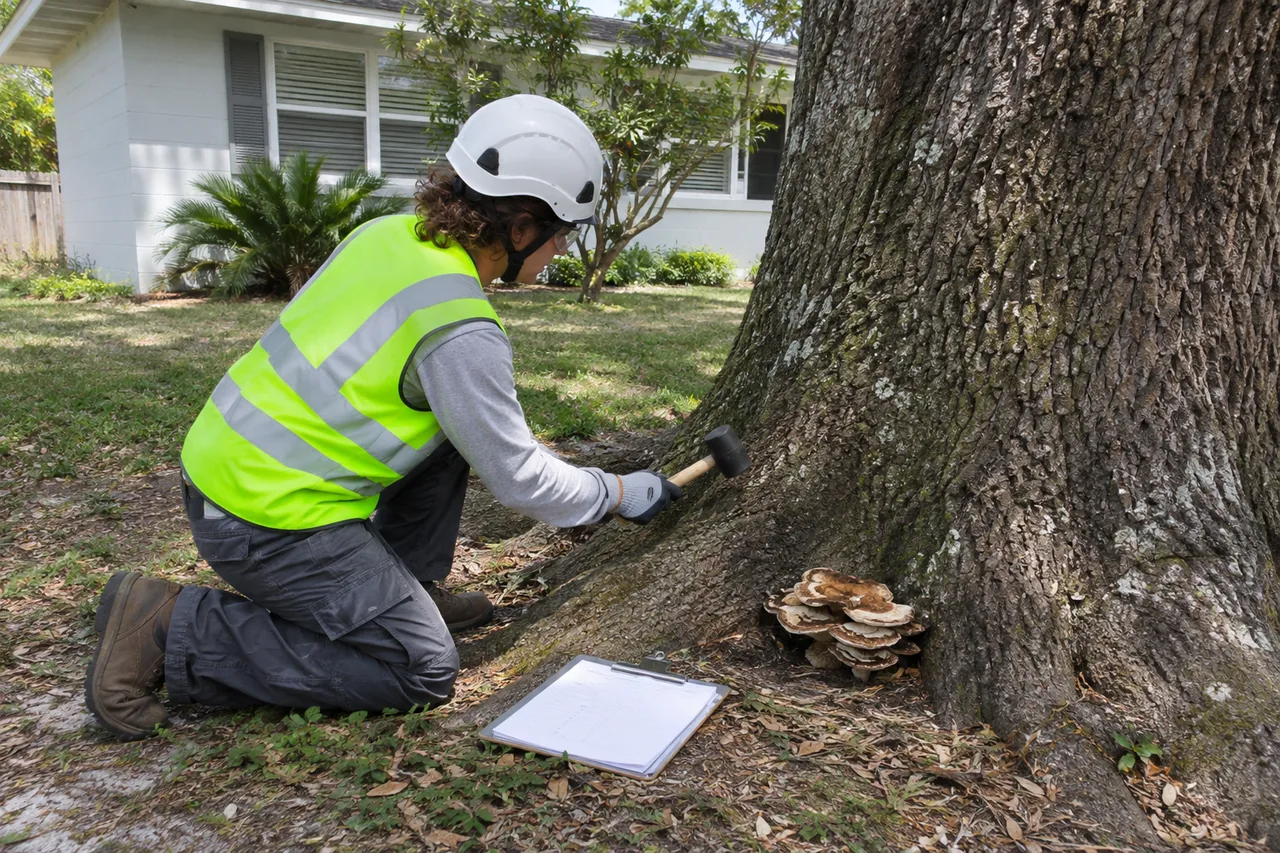
- Photograph the tree, the defect (a crack, a cavity, fungus at the base, a lean that's getting worse) and what it would hit.
- Have the risk assessment done to the BMP Second Edition method and get the signed report.
- Keep the report with your house papers. If the city or a neighbor asks later, it's your proof.
- Have the tree contractor read the report, too: it tells the crew where the weak point is before they rig off it.
- If the tree is 20 inches or more and in Atlantic Beach, call the city first anyway.
None of this is legal advice. The statute's text is short and readable; open it on the Florida Senate's site and read it yourself before relying on it.