
Taking a tree down
Tree Removal in Atlantic Beach, FL
Short answer
Tree removal in Atlantic Beach, FL usually starts with paperwork and ends with a rope: the city's permit is required for trees 8 inches or more in diameter at breast height, and on the close-set lots of Old Atlantic Beach and Selva Marina most big oaks are then taken down in pieces lowered on ropes, because there's no open ground long enough to drop them whole. HomeAdvisor's Jacksonville figures for tree removal and trimming average $975, with most jobs between $474 and $1,501 (HomeAdvisor, undated, checked Nov 28, 2026).
The contractor prices your tree after seeing it, the lot and the wires around it, and tells you whether the city's permit or an arborist's risk assessment has to come first.
Do I need a permit before the tree comes down?
In Atlantic Beach, almost certainly, if the trunk is 8 inches across or more at chest height. The application asks for proof of ownership, a survey or site plan showing which trees go and which stay, a tree inventory and a tree worksheet, and the mitigation plan has to be approved before the trees come out (City of Atlantic Beach, checked Nov 28, 2026). Permits are typically issued 7 to 10 business days after everything is in. Since July 13, 2026, listed maritime species 20 inches and up, live oak among them, need the Community Development Board's approval. Full detail: the Atlantic Beach permit page.
Neptune Beach regulates trees from just over 6 inches, with no permit fee (Neptune Beach rules); Jacksonville Beach protects most trees 6 inches and up but not pines or unplanted palms (Jacksonville Beach rules). On any detached single-family lot, a documented risk assessment under FS 163.045 can take the permit off the table.
How does a tree come down on a beach lot?
- Felled whole. Notch on the side facing open ground, back cut, and it goes over in one piece. It needs a clear landing zone longer than the tree, which on 50- and 75-foot-wide beach lots is rare except for a pine or palm at the back of a deeper yard.
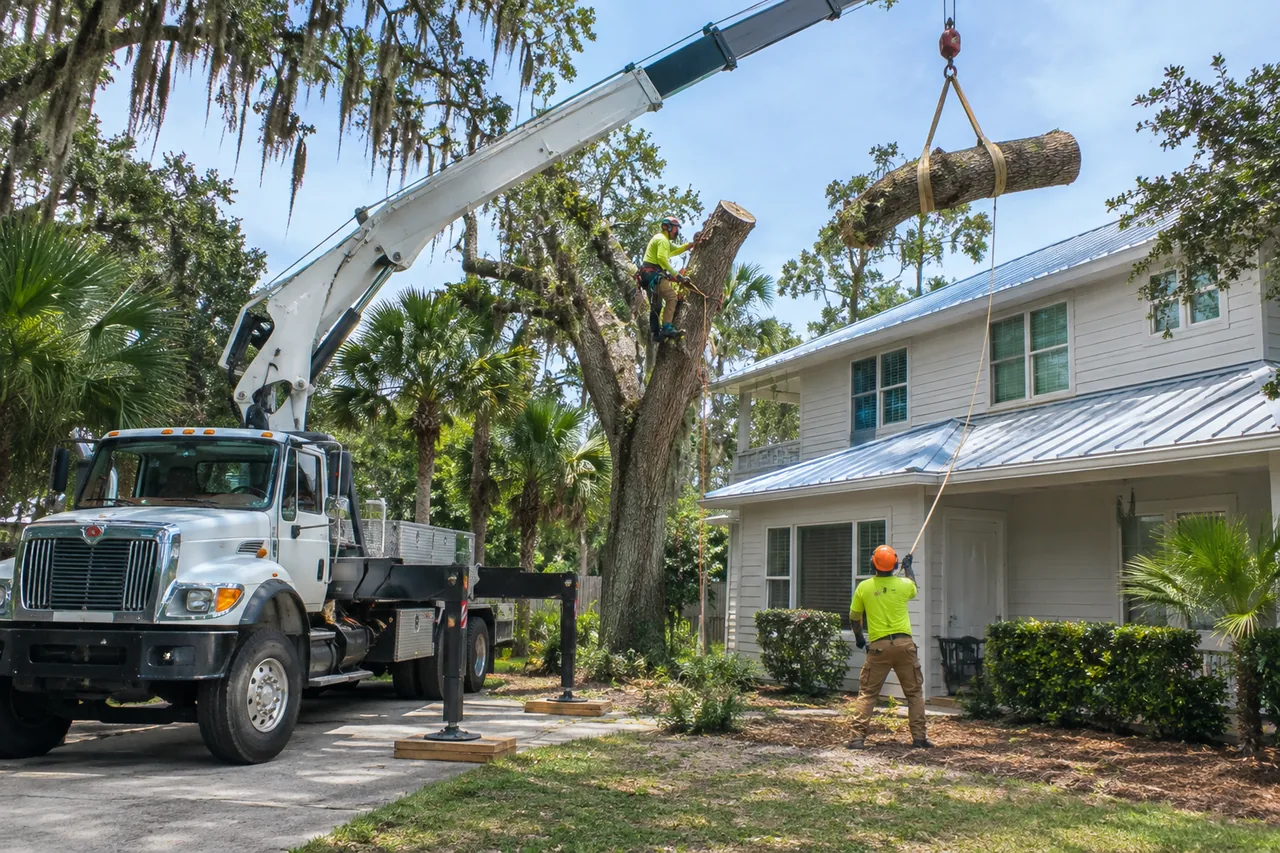
- Sectioned with ropes. A climber ties in high in the crown, or works from a bucket truck, and takes the tree apart from the top down. Each limb and trunk piece is tied off and lowered through a block or pulley set above the cut, with a groundworker running the line through a friction device at the base. This is how most oaks over roofs, pools and screen enclosures come down.
- With a crane. When a tree is dead, split or hanging over the house with no safe way to lower pieces, a crane holds each section as it's cut and sets it in the driveway or the street. HomeGuide adds $500 to $2,500 a day for crane work (HomeGuide, checked Nov 28, 2026).
What makes removals here different?
Small lots, wide trees
A mature live oak can spread wider than the lot it stands on. Limbs reach over the neighbor's roof, the alley and the power drop at once, so nearly every cut is rigged.
Sand under the outriggers
Bucket trucks and cranes set their outriggers on wide pads or timber mats; on soft sand shoulders and over buried irrigation, the pads spread the load. Trucks often work from the street rather than the yard.
Narrow streets and parking
Many beach streets are narrow, with cars on both sides. A chipper and truck may need the curb for a day; the crew sets cones and lets the neighbors know.
Wind off the ocean
Crews watch the sea breeze: a long limb that's easy to control in still air at 8 a.m. sails in a 15-knot onshore wind at 2 p.m.
What happens to the wood and brush?
The crew takes it. Atlantic Beach's solid waste rules say yard waste from tree companies and other landscape or removal contractors must be hauled away by the contractor; the city's hauler, GFL, tags it and leaves it, and fines can follow (City of Atlantic Beach, checked Nov 28, 2026). Burning isn't the answer either: Jacksonville Fire and Rescue's guidance says outdoor burning is prohibited in Duval County without a permit, and under its drought burn ban that month it said all outdoor burning, yard waste and brush included, was prohibited (JFRD, April 21, 2026).
Brush goes through the chipper; logs are cut to length and hauled, or left in rounds if you want firewood. Florida limits moving untreated firewood long distances (more on the dying trees page), so keep it local.
What will the city's mitigation add?
Sometimes more than the tree work. In January 2026 the city calculated that a single 60-inch live oak owed more than 54 inches of replacement trees or about $9,841.88 to the Tree Protection Fund, and a Selva Marina lot split owed 636.5 inches, $115,206.50 (City notice; City notice). A single small yard tree costs far less, but ask Community Development for the calculation before you plan the job. The code prefers replanting or relocating on the lot and reserves the fund for lots where that's restricted (City Code Secs. 23-33 and 23-37, checked Nov 28, 2026).
When does a tree need to come out rather than be trimmed?
- The trunk or a main fork has a crack, a cavity or fungus at the base.
- The crown is more than half dead, or the leaves turned brown all at once (a redbay with laurel wilt, a pine after beetles).
- The tree has started leaning, with sand heaving up on the far side.
- Roots are lifting the slab, the pool deck or the driveway, and cutting them would destabilize the tree.
- A laurel or water oak has grown over the house and is near the end of its natural life.
If a healthy live oak is just in the way, trimming or a crown reduction is usually the better answer, and in Atlantic Beach the city may well say so.
What commonly goes wrong on removals?
- Cutting before the permit. Trees cut without a permit need an after-the-fact permit at twice the fee and are assessed at twice the normal mitigation (City Code Sec. 23-51). The city has also warned residents about a door-to-door tree company soliciting work without the required permit, with citations of up to $500 per violation on the table in its 2022 alert (City of Atlantic Beach).
- Not calling the utility. A section dropped onto the service wire can rip the mast off the house. When a tree is close, ask the utility to drop the service first; the utility decides whether and when.
- Grinding into lines. Stump grinding is excavation under Florida's 811 law. See stump grinding.
- Leaving the stump to rot. Live oak and laurel oak stumps in sand can sprout or settle into a hole over the years.
- A scope that leaves things out. Write down whether the price includes the stump, hauling, and raking the sand smooth.
Questions homeowners ask about removals
How long does a removal take?
A palm or a mid-size pine, a few hours. A big oak over a house, often a full day or more, longer with a crane.
Can the crew take a tree down from my neighbor's yard?
Only with the neighbor's permission. Limbs over the line can be cut back to the line, but working from the other property needs consent.
Who pulls the city permit?
Either the owner or someone with the owner's letter of authorization. Agree in writing which of you is doing it.
Can I keep the wood?
Yes. Say so before the work starts, and say how long you want the rounds cut.